Clearance & Cage Code-Ready
Fixed Ladder Clearances
Fixed ladders built to clearance & cage requirements — full docs: DoC, calcs, MTC 3.1. Get your compliance docs today — talk to our engineers, no obligation.
Rung spacing
Min climbing width
Standard width
Load rating
Fixed Ladder Clearances Key Requirements
10–14 in
Rung spacing (25–36 cm)
7 in min
Rung-to-wall clearance
Cage specs
Per 1910.23(d) & code
Platforms
Walkway & stair spacing per code
Code-Aware Fabrication
Fixed Ladder Clearances
Clearance is the most overlooked dimension on a fixed ladder — and the most likely to fail inspection. We check rung-to-wall, side, front and step-across clearances against the code on every drawing review.
1910.23(d) Compliance
Clearances and rung dimensions addressed on the shop drawing.
Platforms & Walkways per Code
Fixed platforms, walkways, stairways and ladders coordinated.
Compliance DoCs: MTC & Calcs
DoC, structural calcs and MTC 3.1 with every order.
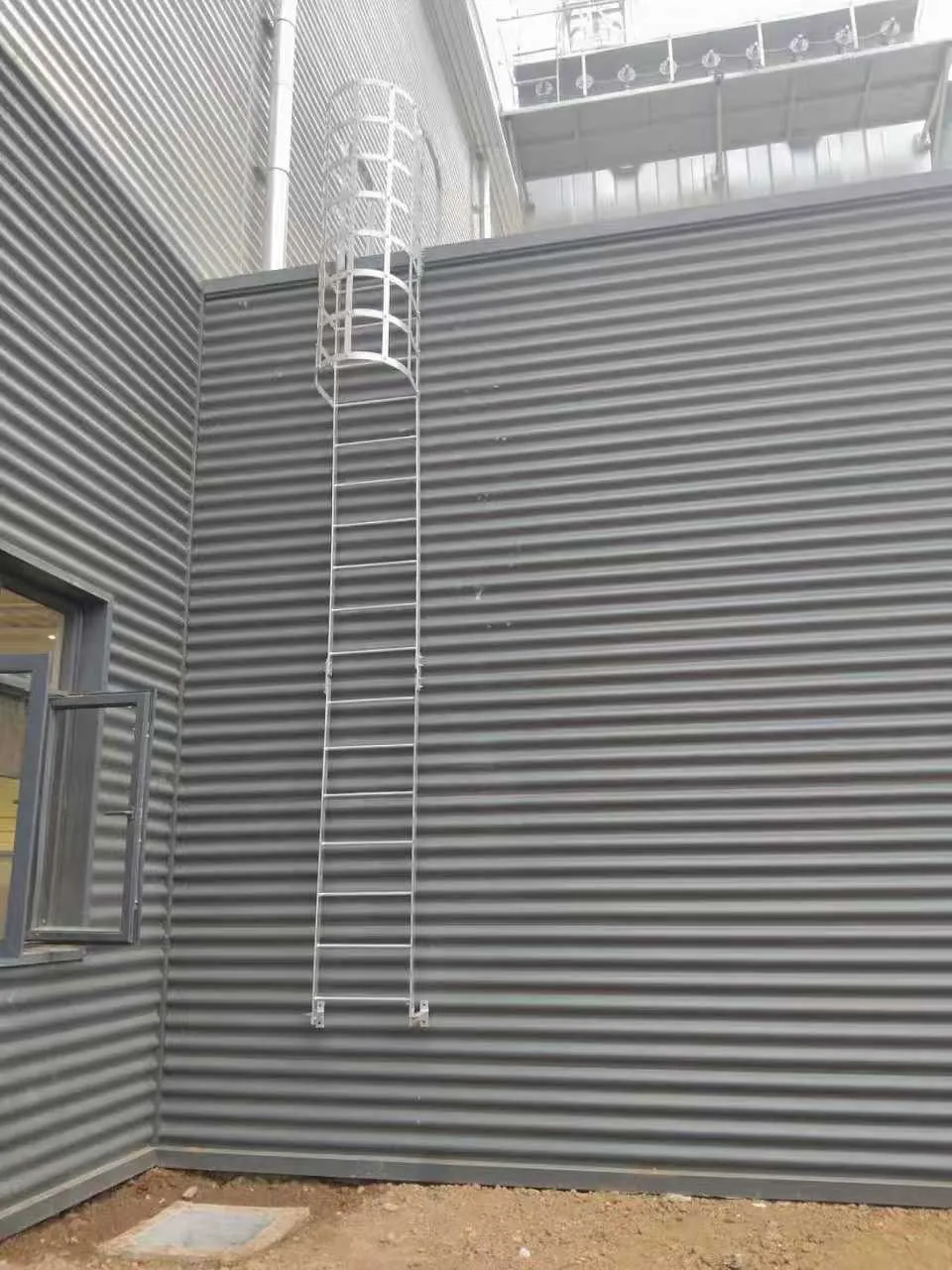
Fixed Ladder Clearances Specifications & Dimensions
| Clearance / Dimension | Code Reference | Dengtai Standard |
|---|---|---|
| Climbing width | ≥16 in (OSHA 1910.23) | 500 mm (19.7″) |
| Rung-to-wall clearance | 7 in min | 200 mm (7.9″) |
| Side clearance | per code | ≥75 mm each side |
| Front clearance at 90° | 30 in (Cal/OSHA) | 760 mm |
| Step-across distance | per 1910.27(c) | 250–300 mm |
| Rung spacing | 10–14 in / 225–300 mm | 280 mm nominal |
| Rung diameter | 0.75 in / 20 mm min | Φ20 mm |
| Load rating | per design load | 1.5 kN per rung |
OSHA Cage Requirements Met
Fixed Ladder Safety Cage Requirements Options & Configurations
Where a cage is still the right answer, the geometry is not optional. Here is what the code demands and how we build it.
| Cage Requirement | OSHA / ANSI Value | Dengtai Build |
|---|---|---|
| Cage start height | 7–8 ft above grade | 2,200–2,400 mm |
| Cage extends above landing | 42 in | 1,070 mm |
| Cage diameter (clearance) | 27–28 in | Φ700 mm |
| Hoop vertical spacing | 4 ft max | 1,200 mm |
| Fall protection trigger | >24 ft PFAS / safety system | PFAS-ready rail option |
Certifications
Compliance & Documentation
- OSHA 1910.23(d) — Clearances
- OSHA 1910.27 — Fixed Ladders
- BS 4211:2005+A1:2015
- EN ISO 14122-4
- AS 1657
Clearance & Cage Documentation Package
Full docs: DoC, calcs and MTC 3.1 — clearance checks documented, not assumed.
- Declaration of Conformity (DoC)
- Material Test Certificates — EN 10204 3.1
- Structural Calculations
- Welding Procedure Specifications
- Surface treatment certificates (HDG per ISO 1461)
2018 Rule Change
Clearances Above 24 ft: Cage-to-PFAS Guidance
The clearance rules change the moment your fixed ladder crosses 24 ft of climb. A cage no longer satisfies the fall-protection requirement on 2018+ installs — a ladder safety system or PFAS takes over, and the clearance band must stay clear of the fall path.
Code-ready deliverables
- 1910.23(d) clearances and cage specs addressed
- Cage-to-PFAS guidance included
- Compliance DoCs: MTC & structural calcs
- Fixed Ladders Worldwide — 50+ countries
Factory-Direct Pricing
Factory-Direct Pricing & 24h Quote
Compliance without markup — material, machining, finishing, packaging, itemized line by line.
Custom quotation priced by weight & process. Industry reference: caged ladders ≈ USD 899–1,099/ton.
Common questions
16 in minimum clear width, 7 in behind the rungs, 30 in side clearance at 90° (36 in at 76° per Cal/OSHA).
Cages start 7–8 ft above the base and extend 42 in above the platform; legacy cages remain compliant until November 2036.
New ladders over 24 ft must use a PFAS or ladder safety system instead of a cage; existing cages phase out by 2036.
Every 50 ft (15 m) of climb, with at least 24 × 30 in of platform area and 42 in guardrails where exposed.
Yes — the DoC names each standard the ladder meets (OSHA, ANSI A14.3, BS 4211, EN ISO 14122-4, AS 1657, SS 553), with calcs and MTC.
Standards Index
Fixed Ladder Standards — Index & How to Choose
Five standards dominate fixed ladder procurement worldwide. This index summarises the essentials of each and the decision path buyers use to pick the right one — we build to all five and ship the matching DoC.
OSHA — United States
- 1910.23(d) sets fixed ladder dimensions — rung spacing 10–14 in, width ≥16 in
- 1910.27 is the dedicated fixed ladder section after the 2017 rewrite
- 1910.28(b)(9): new ladders over 24 ft need PFAS or a ladder safety system — cages no longer count
ANSI A14.3 — United States
- The voluntary design benchmark for fixed ladders, A14.3-2008 (R2018)
- 250 lb (1,113 N) concentrated rung load and 0.75 in minimum rung diameter
- Full cage, well and ladder safety system geometry referenced by OSHA compliance
BS 4211 — United Kingdom
- BS 4211:2005+A1:2008 — the UK specification for permanently fixed ladders
- Rung spacing 225–300 mm, safety hoops at max 900 mm vertical spacing
- Rest platforms at max 9 m intervals, used with WAH 2005 and CDM 2015
EN ISO 14122-4 — European Union
- Harmonised standard for permanent means of access to machinery (2006/42/EC)
- Metric rung, hoop and landing geometry aligned with BS 4211
- Building fixed ladders have no mandatory CE route — the DoC declares the reference used
AS 1657 — Australia
- AS 1657:2018 covers fixed ladders, platforms and walkways
- Rung spacing, cage and landing rules sit under the WHS Regulations 2011 (Cth)
- Fall protection is a stated duty of the person conducting the business — documentation matters
SS 553 — Singapore
- Singapore Standard for fixed ladders and cages on island projects
- Used alongside the WSH (Work at Heights) Regulations 2013 and MOM's Code of Practice
- Fall protection above 3 m is the compliance trigger in practice
| Destination Market | Primary Standard | Also Relevant |
|---|---|---|
| United States | OSHA 1910.27 + ANSI A14.3 | Cal/OSHA in California; state plans |
| United Kingdom | BS 4211:2005+A1:2008 | WAH 2005, CDM 2015 |
| European Union | EN ISO 14122-4:2016 | Machinery Directive; local building codes |
| Australia | AS 1657:2018 | WHS Regulations 2011 (Cth) |
| Singapore / ASEAN | SS 553 | WSH (WAH) Regs 2013, MOM ACOP |
How to Choose: Three Questions
1) Where is the ladder installed? The destination market's regulation decides the primary standard. 2) What is the climb height and frequency? That decides cage versus fall-arrest inside the standard. 3) Who audits it? If a ministry, insurer or principal contractor inspects, take the named DoC — we issue it per order (e.g. OSHA 1910.27 + A14.3 for the US, BS 4211 + EN ISO 14122-4 for the UK, AS 1657 for Australia, SS 553 for Singapore).
Fixed Ladder Standards — FAQ
Your destination market decides. US sites run on OSHA 1910.27 with ANSI A14.3 as the design benchmark; UK sites use BS 4211 under WAH 2005; EU machinery access uses EN ISO 14122-4; Australia uses AS 1657; Singapore uses SS 553 with WSH (WAH) 2013. Tell us the country and we engineer to it.
OSHA is law — enforceable, with mandatory triggers like the 24 ft fall-protection rule. ANSI A14.3 is the voluntary design standard that tells you how to build: geometry, loads and cage details. US projects usually require both, and our DoC declares both.
Yes. The five frameworks share compatible metric and imperial geometry, so we build to the strictest requirement and declare compliance to the standards your market needs — one ladder, multiple named DoCs where required.
Every order ships with a DoC naming your standard, MTC 3.1 material certificates, a pre-shipment inspection report and structural calculations — free, whether the standard is OSHA, ANSI, BS 4211, EN ISO 14122-4, AS 1657 or SS 553.
Proven in real facilities
Reference projects are shown by industry, country and scale. Client names are available on request with approval.
National utility projects — 15+ countries
23 documented projects, 2021-2025 · 2025
All standardsEnergy & industrial clients — Global
500+ projects since 2004 · 2004-2025
Full compliance docsLargest single order — Malaysia
60 units in one project · 2021
HDGGet Your Quote
Talk to an Engineer
Free drawing review. Itemized quote in 24 hours. No obligation.
Why Work With Dengtai?
Full Compliance Docs
DoC, MTC, structural calcs included free.
24-Hour Quote
Engineering review + itemized quote within one day.
Global Delivery
8–12 containers/month. VCI + ISPM 15 packaging.
Request a Quote
Related Fixed Ladder Clearances Pages
Clearances, cages and platforms — the three dimensions that decide compliance.
OSHA 1910.27 Fixed Ladders
The 29 CFR 1910.27 standard with every number
OSHA Fixed Ladder Rules
1910.23 and 1910.27 rules side by side
Cage Fixed Ladders
Safety cage requirements in practice
Fixed Ladders with Platform
Rest platforms and walk-thru configurations
Fixed Ladder Safety Cage
When cages still count and how to spec them
All Ladder Standards
OSHA, BS 4211, EN ISO 14122-4 and AS 1657