HSE & Work at Height 2005
HSE Fixed Ladders
HSE-compliant fixed ladders with full docs — BS 4211 DoC, structural calcs, MTC 3.1. Rest platforms within 9m, hoops laid out per WAH 2005 guidance.
Rung spacing
Climbing width
Load rating
Per order
HSE & WAH 2005 Key Requirements
BS 4211 DoC
Included with every order
Within 9 m
Rest platform spacing
Safety hoops
Laid out per WAH 2005
Structural calcs
Plus MTC 3.1 per order
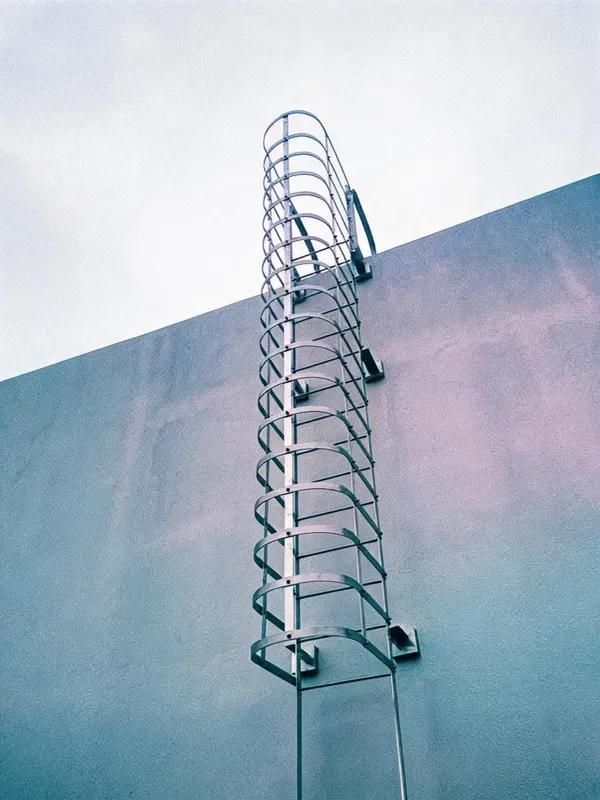
HSE Compliance Specialists
Hse Fixed Ladders
For UK sites, "HSE compliance" means the Work at Height Regulations 2005 hierarchy applied through BS 4211 and EN ISO 14122-4. That is exactly the checklist we build to.
| HSE / WAH 2005 Rule | How it lands on a fixed ladder |
|---|---|
| WAH 2005 hierarchy | Fixed access justified where work at height cannot be avoided — documented in your file. |
| Rest platforms within 9 m | Ladder runs longer than 9 m need a rest platform — we lay them out in the drawing review. |
| Hoops per WAH guidance | Safety hoop start, spacing and offset arranged per BS 4211 and WAH 2005 guidance. |
| Fall-arrest alternative | Rail and cable fall-arrest systems offered where the hierarchy prefers them. |
| CDM 2015 paperwork | DoC, calcs and MTC 3.1 packaged for the principal designer. |
HSE-Focused Supplier
Fixed ladders engineered for UK site managers and their duty of care.
WAH 2005 Compliance
Rest platforms within 9 m and hoops laid out per guidance.
HSE DoCs: BS 4211 DoC
BS 4211 DoC with MTC & structural calcs per order.
UK vs EU vs US
HSE Fixed Ladders Options & Configurations
The UK fixed ladder spec is metric and hoop-centric. Here is how it compares — and the options we offer on each.
| Requirement | HSE / WAH 2005 | BS 4211 | EN ISO 14122-4 |
|---|---|---|---|
| Rung spacing | 225–300 mm | 225–300 mm | 225–300 mm |
| Climbing width | 400–600 mm | 400–600 mm | 400–600 mm |
| Rest platforms | within 9 m | ~9 m intervals | ~9 m intervals |
| Fall protection | hoops or fall-arrest | safety hoops or fall-arrest | hoops or fall-arrest |
| Key regs | WAH 2005, CDM 2015 | BS 4211:2005+A1:2015 | EN ISO 14122-4 |
Hoop-Guarded
BS 4211 safety hoops for UK fixed ladder runs.
Fall-Arrest Rail
Rail systems for taller UK and EU installations.
Rest Platform Sets
Landings every 9 m with companionway access.
Certifications
Compliance & Documentation
- BS 4211:2005+A1:2015
- EN ISO 14122-4
- Work at Height Regs 2005
- CDM 2015 support docs
- OSHA 1910.27
HSE Documentation Package
BS 4211 + EN ISO 14122-4 DoC per order — aligned with WAH 2005 and CDM 2015.
- Declaration of Conformity (DoC)
- Material Test Certificates — EN 10204 3.1
- Structural Calculations
- Welding Procedure Specifications
- Surface treatment certificates (HDG per ISO 1461)
Fall Protection
HSE-Compliant Hoops & Fall-Arrest
HSE guidance treats ladders as work at height — so the fall protection decision is part of the design, not an afterthought. We lay hoops per BS 4211 and offer rail fall-arrest where the hierarchy prefers it.
HSE-backed deliverables
- BS 4211 + EN ISO 14122-4 DoC per order
- Aligned with Work at Height Regs 2005 & CDM 2015
- HSE DoCs: MTC & structural calcs
- HSE Ladders for the UK & EU
Factory-Direct Pricing
Factory-Direct Pricing & 24h Quote
HSE compliance at a fair price — material, machining, finishing, packaging, itemized line by line.
Custom quotation priced by weight & process. Industry reference: caged ladders ≈ USD 899–1,099/ton.
Dimensions
Hse Fixed Ladders Specifications & Dimensions
Standard heights 3–7.6 m, custom engineering to 12 m. Metric dimensions verified against BS 4211 and EN ISO 14122-4.
| Specification | Standard Range |
|---|---|
| Rung diameter | Φ20 mm min |
| Rung spacing | 225–300 mm |
| Clear width | 400–600 mm |
| Rest platforms | within 9 m |
| Load rating | 1.5 kN per rung |
| Material | Q235B / SS304 / SS316 |
| HDG thickness | 85–100 μm (ISO 1461) |
| Fall protection | Hoops or fall-arrest |
Regulation-by-Regulation
HSE Fixed Ladders — Work at Height Regulations 2005 in Practice
HSE does not publish its own fixed-ladder standard. In the UK, fixed ladders are governed by the Work at Height Regulations 2005 (SI 2005/735) and detailed through BS 4211 and EN ISO 14122-4. Here is how the regulations land on your ladder.
Reg 4
Avoid Work at Height
Work at height must be avoided where reasonably practicable. When access is unavoidable, the means of access must be safe — which is where a properly specified fixed ladder earns its place in the risk assessment.
Reg 6
Safe Places & Means of Access
Reg 6 requires every place of work and every means of access to be safe, with work equipment selected accordingly. A fixed ladder designed to BS 4211 — correct rung spacing, hoops and rest platforms — is part of that duty.
9 m
The Rest Platform Rule
HSE guidance and BS 4211 agree: climbs longer than 9 m need a rest platform, and long or frequent climbs push the design toward rail fall-arrest. We mark the 9 m breaks on your elevation in the drawing review.
| WAH 2005 / HSE Element | What It Requires | On Your Fixed Ladder |
|---|---|---|
| Reg 4 — Avoidance | Avoid work at height where practicable | Access route justified in the risk assessment |
| Reg 6 — Safe access | Safe places of work and means of access | Ladder sized to BS 4211 geometry and use frequency |
| Reg 8 — Fall prevention | Prevent falls; collective protection first | Hoops or rail fall-arrest decided in design |
| HSE guidance | Rest platforms within 9 m on tall climbs | Landings laid out at ≤9 m intervals |
| CDM 2015 | Designers must consider health and safety | DoC + structural calcs support the design file |
The Hierarchy in Practice
WAH 2005 asks for collective protection before personal protection. For fixed access, that means a permanently installed, code-geometry ladder with hoops or a fall-arrest rail — not a portable ladder — whenever the location is used regularly. The hierarchy is applied at the drawing stage, not after delivery.
Hoops or Fall-Arrest — the HSE Answer
WAH 2005 does not prescribe hoops; it prescribes the outcome — no fall. BS 4211 gives you the hoop geometry; the risk assessment decides whether hoops are enough. Tall, frequent or two-way traffic climbs get a fall-arrest rail. We give you both options priced separately.
WAHR 2005 — Clause by Clause
| WAHR 2005 Provision | What It Requires | On Your Fixed Ladder |
|---|---|---|
| Reg 4 — Organisation & planning | Work at height properly planned, appropriately supervised and carried out safely; the plan includes emergencies and rescue (Reg 4(1)-(2)) | The MHSWR risk assessment drives the access plan; the ladder choice is justified in your WAH file |
| Reg 6(3) — Fall prevention | Suitable and sufficient measures to prevent a person falling a distance liable to cause personal injury (Reg 6(3)) | A permanently installed ladder with hoops or fall-arrest rail is the engineered measure |
| Reg 6(4)(a) — Existing means of access | Carry out the work from an existing place of work or existing means of access complying with Schedule 1, where reasonably practicable (Reg 6(4)(a)) | A properly installed fixed ladder becomes the site's existing means of access |
| Reg 6(4)(b) — Work equipment | Where that is not reasonably practicable, provide sufficient work equipment to prevent a fall (Reg 6(4)(b)) | Ladder engineered to BS 4211 / EN ISO 14122-4 with 1.5 kN rated rungs |
| Reg 7 — Selection of work equipment | Collective protection takes priority over personal protection; weigh fall distance and consequences, duration and frequency of use (Reg 7(1)) | Hoops and rest platforms before harnesses; rail fall-arrest where the risk assessment justifies it |
| Reg 12 — Inspection & records | Equipment exposed to deterioration inspected at suitable intervals; results recorded and kept until the next inspection is recorded (Reg 12(3),(6)) | Pre-use checks plus periodic inspections logged per ladder, records retained |
| Schedule 6 — Ladder conditions | Ladder used only for low-risk, short-duration work; stable and firm support; secured against slipping; rest platforms at 9 m intervals (Sch 6 paras 1, 2, 5, 9) | 225–300 mm rung spacing, rigid fixings, landings at ≤9 m |
Inspection & Records — the Reg 12 Duty
Reg 12 requires equipment exposed to deterioration to be inspected at suitable intervals, with results recorded and kept until the next inspection is recorded. On a fixed ladder that means a pre-use visual check before each working period, plus a detailed inspection by a competent person at planned intervals — typically every 6–12 months, more often in corrosive or high-use environments. Working platforms above 2 m used for construction must be inspected within the previous 7 days, and inspection reports stay on site until the work is complete, then at the office for 3 months (Reg 12(4),(8)).
UK Site Inspection Checklist
- Rungs — uniform 225–300 mm spacing, no loose, worn or corroded rungs, no coating defects hiding cracks.
- Fixings — stile brackets tight to wall or structure, anchor torque verified, no missing bolts or weld cracks.
- Fall-arrest rail & cage — rail straight and free of dents, slider runs smoothly, cage hoops intact and evenly spaced.
- Corrosion & coating — HDG 85–100 μm intact, no rust bloom at welds or cut edges, SS304/SS316 free of pitting.
EN ISO 14122-4:2016 — the Engineering Route
WAHR 2005 sets the outcome — a ladder that is reasonably safe and stable for its intended use. EN ISO 14122-4:2016 (harmonised under the Machinery Directive 2006/42/EC and cited in our DoC) is the engineering route HSE accepts in practice: rungs rated at 1.5 kN each without permanent deformation, fall protection above 3 m (safety cage or guided fall-arrest), rest platforms on climbs above 10 m, and rung spacing held uniform at 225–300 mm. Designing to EN ISO 14122-4 is how a fixed ladder demonstrates the Reg 6(4) safe-means-of-access duty in measurable terms.
The 2 m Figure in Inspection Practice
WAHR 2005 sets no blanket height trigger, but the 2 m figure still governs inspection practice: a working platform used for construction work from which a person could fall 2 m or more must be inspected in position within the previous 7 days (Reg 12(4)). On tall or frequent climbs we default to rail fall-arrest — the protection is engineered in from the drawing stage, not bolted on later.
HSE Fixed Ladders — FAQ
Yes — HSE accepts fixed ladders where work at height cannot be avoided and the access is safe for its intended use. The WAH 2005 risk assessment records the decision; BS 4211 geometry and the 9 m rest platform rule make it defensible.
HSE guidance and BS 4211 put rest platforms at maximum 9 m intervals on a fixed ladder climb. Any run longer than 9 m is split with a landing, and long or frequent climbs move toward rail fall-arrest.
WAH 2005 requires fall prevention rather than a specific device. Hoops per BS 4211 satisfy it for typical climbs; the risk assessment may demand a fall-arrest rail for tall, frequent or high-consequence access. We document either choice.
The risk assessment plus the design file: DoC referencing BS 4211:2005+A1:2008 and EN ISO 14122-4:2016 (aligned with WAH 2005 and CDM 2015), MTC 3.1 material certificates and structural calculations — all shipped free with the order.
Yes — climbing and working from a ladder is work at height under WAH 2005, so the regulations apply to use as well as design. That is why inspection and maintenance of rungs, hoops and fixings matter, and why our pre-shipment inspection report ships with every unit.
Common questions
The Health and Safety Executive — the UK regulator behind the Work at Height Regulations 2005 and CDM 2015 that govern fixed ladder design and use on UK sites.
BS 4211:2005+A1:2008 and EN ISO 14122-4:2016, with hoops, rungs and rest platforms laid out per WAH 2005 guidance — documented in the DoC.
Φ20 mm rungs at 225–300 mm spacing, 400–600 mm clear width, rated 1.5 kN per rung, in Q235B HDG, SS304 or SS316.
Yes — HSE ladders ship to UK and EU sites with a BS 4211 DoC per order, aligned with the Work at Height Regulations 2005 and CDM 2015.
Standard heights run 3–7.6 m, with custom engineering to 12 m for taller climbs.
Proven in real facilities
Reference projects are shown by industry, country and scale. Client names are available on request with approval.
National utility projects — 15+ countries
23 documented projects, 2021-2025 · 2025
All standardsEnergy & industrial clients — Global
500+ projects since 2004 · 2004-2025
Full compliance docsLargest single order — Malaysia
60 units in one project · 2021
HDGGet Your Quote
Talk to an Engineer
Free drawing review. Itemized quote in 24 hours. No obligation.
Why Work With Dengtai?
Full Compliance Docs
DoC, MTC, structural calcs included free.
24-Hour Quote
Engineering review + itemized quote within one day.
Global Delivery
8–12 containers/month. VCI + ISPM 15 packaging.
Request a Quote
Related Hse Fixed Ladders Pages
From BS 4211 to US OSHA — compare standards and start your HSE project.
BS 4211 Fixed Ladders
The UK standard behind HSE compliance
Fixed Ladder Standards
Clearances, cages and platform spacing
OSHA 1910.27 Fixed Ladders
The US counterpart with imperial dimensions
ANSI A14.3 Fixed Ladders
North American fixed ladder standard
Fixed Ladder Installation
Guides and requirements for UK and US sites
All Ladder Standards
OSHA, BS 4211, EN ISO 14122-4 and AS 1657